Why one website costs €400 and another €4,000
A plain breakdown of what drives website pricing and what you actually get.
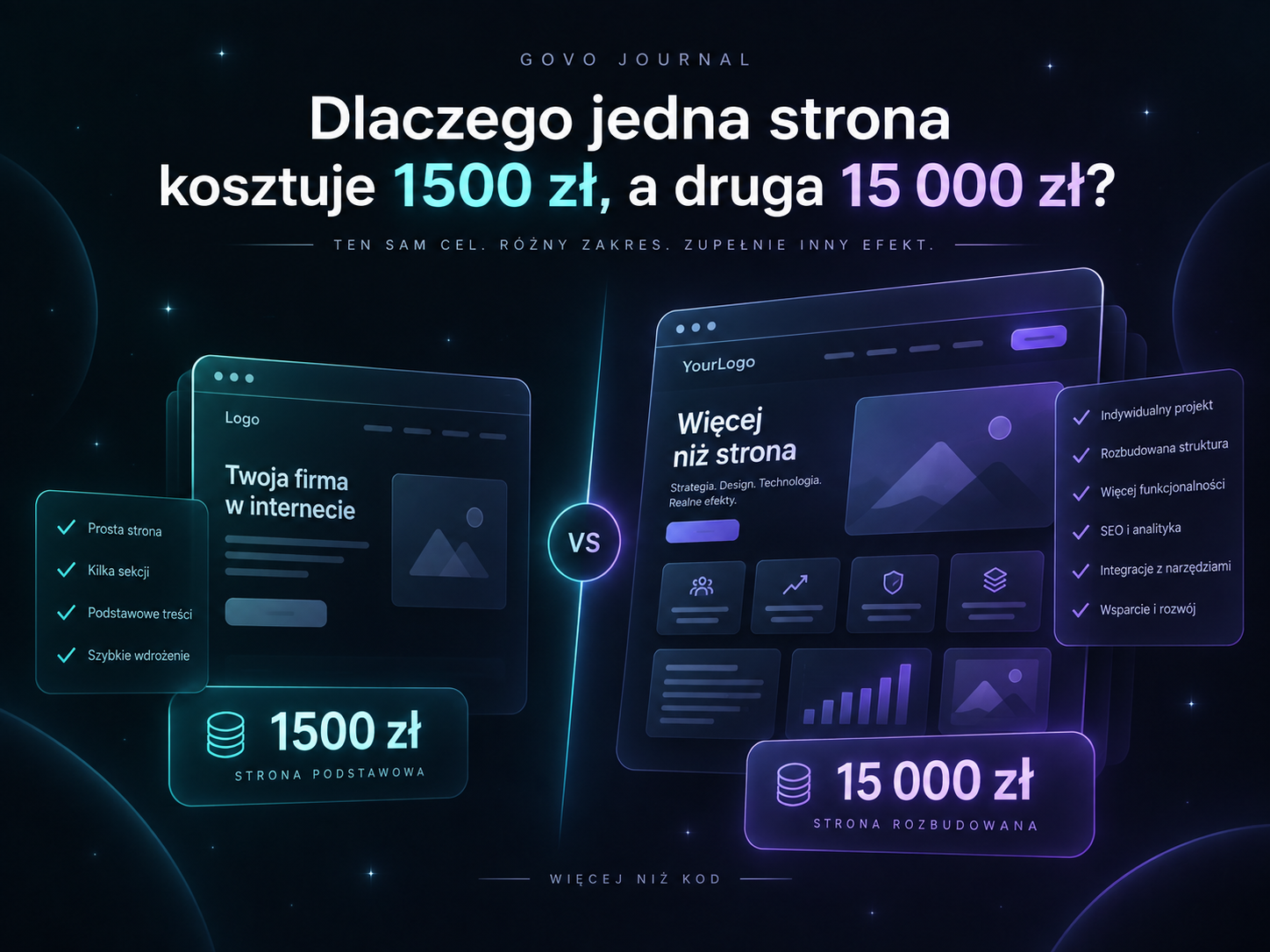
At first glance both can look similar. A logo. A menu. A few sections. A contact form. So why does one quote come in at €400 and another at €4,000? Because the number of screens is only part of the price. The biggest differences hide in what is not visible at first sight: scope, process, number of decisions, technology and responsibility.
01First things first: more expensive does not always mean better
A €4,000 website is not automatically ten times better than a €400 one. Likewise, a low price does not automatically mean poor work. The right price depends mainly on what the site is supposed to do. A simple landing page for one service does not need a process comparable to building a platform, shop or extensive corporate site. Paying €4,000 for a simple business card can be just as senseless as trying to build complex e-commerce for €400.
02€400 can mean exactly what you need
Imagine a small service business. It has a ready logo. Ready copy. Photos. It needs a few sections: offer, portfolio, about, contact. No client panel. No unusual integrations. No elaborate animation system. Such a project can be relatively quick. The scope is clear, the number of decisions is limited and technically there is no need to build an entire ecosystem. Then a lower quote is completely rational.
03Price rises when the number of unique decisions rises
Five subpages do not always mean five times more work. If each uses a similar component system, subsequent views can be built efficiently. A different story is a project where every part of the site has: a different structure, different interactions, different behaviour and its own set of features. Then you are not paying for "another page". You are paying for another problem to design and solve.
04Custom design takes more than choosing a template
A ready-made theme can be a great solution. But it imposes certain decisions from the start. If a project is built from scratch, someone has to decide on: content hierarchy, grid, typography, section rhythm, component behaviour, mobile version, interaction states and the whole visual system. This does not always mean hundreds of hours. But it does mean more conscious decisions. And decisions are a big part of design value.
05Content can change a quote more than design
A project with ready, well-prepared materials moves faster. If the contractor first has to understand the offer, organise it, outline the structure and help create the copy, the scope starts to look more like strategic work than just "making a website". That is why two visually similar sites can have completely different budgets. One was simply an implementation. The other started from a blank sheet.
06Animations can be cheap. And they can be very expensive
A simple element fade-in is a moment's work. A scroll-controlled sequence, custom cursor, animated transitions between views, WebGL or complex interactions require much more. They have to be: designed, implemented, tested on devices and checked that they do not hurt performance. That is why "we want a bit of animation" can mean either an hour or several days of work.
07Integrations turn a site into a system
A form that sends an email is simple. A form that: qualifies the lead, saves data in a CRM, sends an automatic message, tracks the UTM source and triggers further actions is a different scale of project. The same with a shop. A product card is UI. But payments, delivery, taxes, stock levels, variants, transactional emails and the order system create an entire process. That is why e-commerce costs can grow very quickly.
08Responsibility is also part of the price
A small build is often done by one person. A larger project may involve: a strategist, designer, developer, copywriter, project manager, SEO specialist. Each extra person increases the cost. But it also increases the available competence and responsibility. A big agency will have higher costs than a freelancer. That does not automatically make it the better choice. It means it sells a different collaboration model.
09So what are you really buying?
Not a "website". You are buying a specific solution scope. A simple site may need: ready content, a few views, basic UI and a smooth launch. A complex project may require: strategy, information architecture, custom design, many responsive variants, complex frontend, integrations, analytics, SEO migration and a long testing process. Both products are called "websites". It is a bit like comparing a studio flat and a hotel because both have doors and windows.
10How to compare quotes
Do not look only at the final amount. Check first: what exactly is in scope. Do you get an individual design? How many views? Is mobile designed separately? Does the contractor help with structure? Are hosting and launch included? What about revisions? Who is responsible for copy? What about integrations? Do the code and project rights stay with you? Only then can two quotes really be compared.
Want to see what your specific project might cost? Get in touch
Want to apply this to your site?
Get in touch about your project — we start with a short call about the goal.
Let's talk